This past Saturday, August 4, we were fortunate to have 31 people join us for Divine Liturgy. This group included three new regulars and the return of the Alford family, now five strong after a year in Serbia (there is no evidence to support that each time they visit Serbia they return with more children).

It was the feastday of the Seven Holy Sleeping Youths, who were persecuted under the Roman Emperor Decius and were miraculously preserved alive, but sleeping, in a cave for 200 years, and reemerged during the reign of Theodosius II. Their emergence from the cave wherein they had been immured alive dealt a great blow to the heretics in the area of Ephesus, who had denied the general bodily resurrection of the dead, which precedes the Great and Final Judgment. After their appearance and a brief questioning by the local governor and the local bishop, the youths returned to their cave. Theodosius II, while shortly thereafter passing through Ephesus, spoke with the youths, and then they went to sleep in their cave, awaiting the general resurrection of the dead.

Here Fr. Benedict Crawford begins the vesting prayers. He is dressed in his cassock. Fortunately for our worship, the chapel faces East, which is the symbolic orientation of Jerusalem, where Christ was crucified, buried, rose from the dead, and wherefrom he ascended into Heaven. Orthodox churches are liturgically oriented with the altar at the East of the building.

A visually stunning picture of the small stained-glass window at the front of the church illumined by the mid-morning sun.

Here Fr. Benedict has just completed the public portion of the vesting prayers, after which he would repair behind the iconostasis, or icon screen, which symbolically references the curtain in the Temple, behind which only those priests consecrated to serve in a particular year could go. Note to self: discuss the nature of the mystical priesthood of the Orthodox Church. Further note to self: get a better understanding of the mystical nature of priesthood first.

Here Fr. Benedict has finished putting on his white sticharion, which is different than the sticharion worn by the altar servers, subdeacons, and deacons. The two analogia, or icon stands, have purple covers, indicating that the church is in a fasting period. In this case, we are in the heart of the Dormition fast, which is the two-week fast immediately preceding the feast day that commemorates the falling asleep of the Virgin Mary. Catholics refer to this feast day as "Assumption," due to the Roman belief that the Virgin Mary was assumed bodily into heaven instead of passing away. The Holy Tradition of the Orthodox Church teaches us that the Virgin Mary passed away into sleep while surrounded by the Apostles, and her soul passed directly into Heaven. Then the Theotokos was resurrected in the body on the third day after her repose.

Here the north end of the altar table is set up for proskomide, which is the service for the preparation of the Host for communion. The five loaves will be cut and divided while a series of prayers is said. Each portion of the bread that is cut has a symbolic, commemorative significance. The knife that is used to cut the prosphora is called the spear, after the spear that pierced Christ's side. The chalice is the heavy ornate bronze cup from which we commune. The Orthodox practice a full, closed communion, meaning that the bread and wine are mixed when consecrated, and taken together, and that you have to be an Orthodox Christian in good standing to commune. The brass raised plate next to the chalice is the paten, which holds the prosphora until the consecration, when the Host is placed in the chalice. The two cruets hold water and wine, which are commingled in the chalice during proskomide. The blue altar cloths are placed over the paten and the chalice later.

Here Fr. Benedict begins the prayers of the proskomide. Blue vestments are customary for the feasts of the Theotokos, and during the Dormition fast. Fr. Benedict is wearing what is commonly referred to as Athonite or Russian vestments, with a high back that rests on his shoulders.

Here the Host is ready, at the conclusion of the proskomide service. The large triangle to the left of the Host symbolizes the Virgin Mary; the nine small triangles to the right of the host symbolize, from left top going down the rows, the following: 1) St. John the Baptist, the Forerunner, the Prophet of the New Testament; 2) the Old Testament prophets and all holy prophets; 3) the Holy Apostles; 4) the holy hierarchs of God; 5) the holy martyrs of God; 6) the holy and venerable fathers and mothers (ascetic saints); 7) the holy unmercenaries (healers); 8) the forebears of God Joachim and Anna and the saints Equal-to-the-Apostles; 9) the saint whose liturgy is celebrated that day (either St. John Chrysostom or St. Basil the Great). The rows below the Host symbolize the living and the dead, according to the list Fr. Benedict had at the table with him.

Fr. Benedict here has moved the paten and chalice to the side altar table, usually called the proskomide table. The altar table has on it the Gospel, which rests atop the folded up antimension, or altar cloth, which may be carried and used anywhere for a eucharistic service. The antimension has sewn into it relics of a saint, and has been consecrated by a bishop and blessed for eucharistic services. Next to the Gospel and antimension are the communion cloth, upon which sits the spoon and the spear, and above which sit the blessing cross. Our blessing cross is a travel blessing cross from Russia. Most Orthodox blessing crosses are quite large. Ours is small, simply because we are a small mission and don't have our own space.

Here Fr. Benedict preaches a sermon on the miracle of the feeding of the multitudes with the seven loaves and a few fishes. In the life of the Church and in the Gospels, this is the second such feeding which is read about in the Church. Fr. Benedict told us that we should be astounded by this, and particularly because the Apostles were astounded by this, and this was the second time in Christ's ministry that he had done this. The Apostles should have remembered. And so should we, and we should marvel at it.

The Alfords, back where they should be (with us in the mission). Note the large vascular surgeon in the background. Please note that although we are sitting, this is only during the sermon. We worship on our feet, or on our knees.
These photos were taken by me, on my camera phone. The quality of the photos are a direct reflection of my quality as a photographer.

It was the feastday of the Seven Holy Sleeping Youths, who were persecuted under the Roman Emperor Decius and were miraculously preserved alive, but sleeping, in a cave for 200 years, and reemerged during the reign of Theodosius II. Their emergence from the cave wherein they had been immured alive dealt a great blow to the heretics in the area of Ephesus, who had denied the general bodily resurrection of the dead, which precedes the Great and Final Judgment. After their appearance and a brief questioning by the local governor and the local bishop, the youths returned to their cave. Theodosius II, while shortly thereafter passing through Ephesus, spoke with the youths, and then they went to sleep in their cave, awaiting the general resurrection of the dead.

Here Fr. Benedict Crawford begins the vesting prayers. He is dressed in his cassock. Fortunately for our worship, the chapel faces East, which is the symbolic orientation of Jerusalem, where Christ was crucified, buried, rose from the dead, and wherefrom he ascended into Heaven. Orthodox churches are liturgically oriented with the altar at the East of the building.

A visually stunning picture of the small stained-glass window at the front of the church illumined by the mid-morning sun.

Here Fr. Benedict has just completed the public portion of the vesting prayers, after which he would repair behind the iconostasis, or icon screen, which symbolically references the curtain in the Temple, behind which only those priests consecrated to serve in a particular year could go. Note to self: discuss the nature of the mystical priesthood of the Orthodox Church. Further note to self: get a better understanding of the mystical nature of priesthood first.

Here Fr. Benedict has finished putting on his white sticharion, which is different than the sticharion worn by the altar servers, subdeacons, and deacons. The two analogia, or icon stands, have purple covers, indicating that the church is in a fasting period. In this case, we are in the heart of the Dormition fast, which is the two-week fast immediately preceding the feast day that commemorates the falling asleep of the Virgin Mary. Catholics refer to this feast day as "Assumption," due to the Roman belief that the Virgin Mary was assumed bodily into heaven instead of passing away. The Holy Tradition of the Orthodox Church teaches us that the Virgin Mary passed away into sleep while surrounded by the Apostles, and her soul passed directly into Heaven. Then the Theotokos was resurrected in the body on the third day after her repose.

Here the north end of the altar table is set up for proskomide, which is the service for the preparation of the Host for communion. The five loaves will be cut and divided while a series of prayers is said. Each portion of the bread that is cut has a symbolic, commemorative significance. The knife that is used to cut the prosphora is called the spear, after the spear that pierced Christ's side. The chalice is the heavy ornate bronze cup from which we commune. The Orthodox practice a full, closed communion, meaning that the bread and wine are mixed when consecrated, and taken together, and that you have to be an Orthodox Christian in good standing to commune. The brass raised plate next to the chalice is the paten, which holds the prosphora until the consecration, when the Host is placed in the chalice. The two cruets hold water and wine, which are commingled in the chalice during proskomide. The blue altar cloths are placed over the paten and the chalice later.

Here Fr. Benedict begins the prayers of the proskomide. Blue vestments are customary for the feasts of the Theotokos, and during the Dormition fast. Fr. Benedict is wearing what is commonly referred to as Athonite or Russian vestments, with a high back that rests on his shoulders.
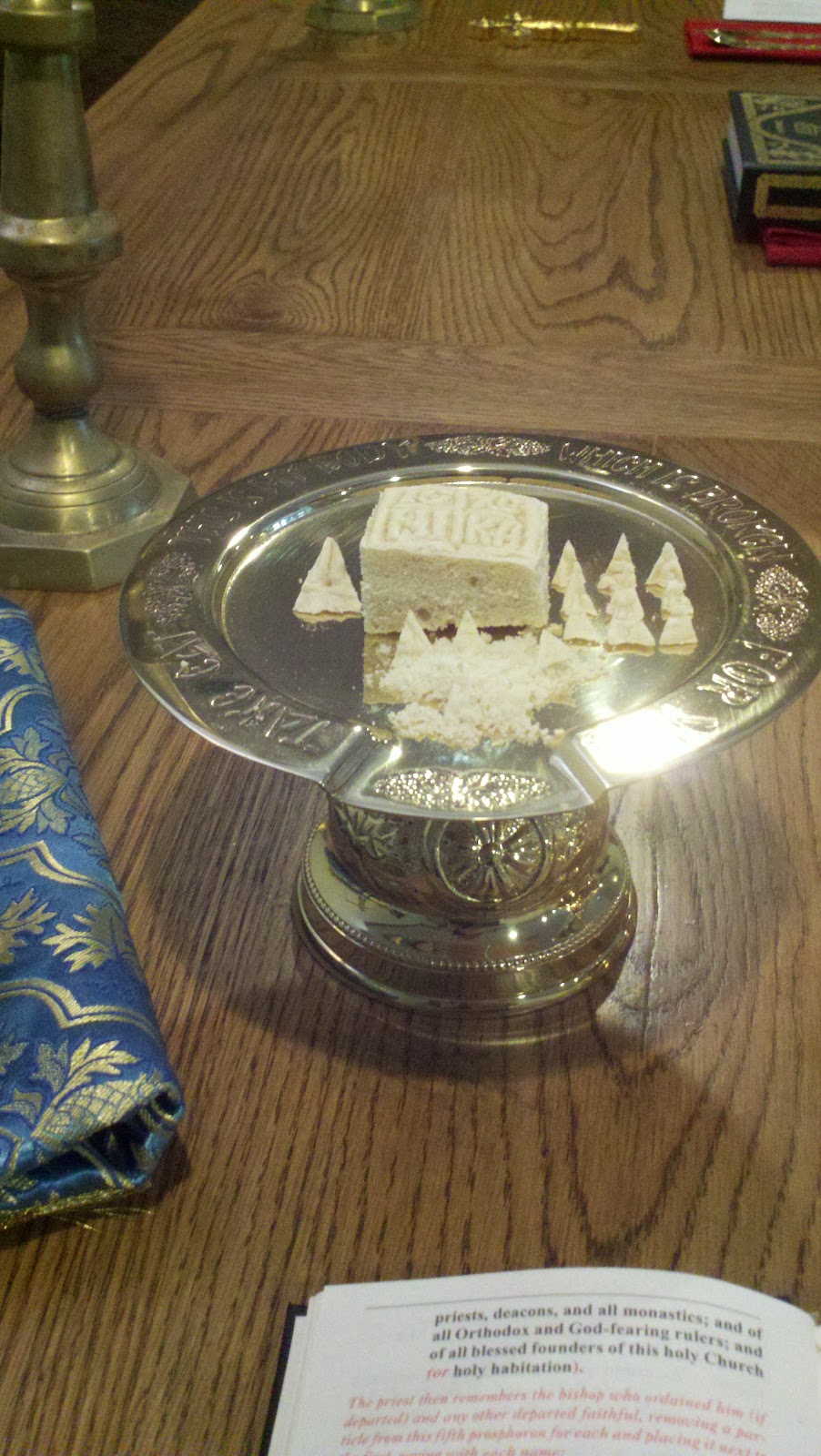
Here the Host is ready, at the conclusion of the proskomide service. The large triangle to the left of the Host symbolizes the Virgin Mary; the nine small triangles to the right of the host symbolize, from left top going down the rows, the following: 1) St. John the Baptist, the Forerunner, the Prophet of the New Testament; 2) the Old Testament prophets and all holy prophets; 3) the Holy Apostles; 4) the holy hierarchs of God; 5) the holy martyrs of God; 6) the holy and venerable fathers and mothers (ascetic saints); 7) the holy unmercenaries (healers); 8) the forebears of God Joachim and Anna and the saints Equal-to-the-Apostles; 9) the saint whose liturgy is celebrated that day (either St. John Chrysostom or St. Basil the Great). The rows below the Host symbolize the living and the dead, according to the list Fr. Benedict had at the table with him.

Fr. Benedict here has moved the paten and chalice to the side altar table, usually called the proskomide table. The altar table has on it the Gospel, which rests atop the folded up antimension, or altar cloth, which may be carried and used anywhere for a eucharistic service. The antimension has sewn into it relics of a saint, and has been consecrated by a bishop and blessed for eucharistic services. Next to the Gospel and antimension are the communion cloth, upon which sits the spoon and the spear, and above which sit the blessing cross. Our blessing cross is a travel blessing cross from Russia. Most Orthodox blessing crosses are quite large. Ours is small, simply because we are a small mission and don't have our own space.

Here Fr. Benedict preaches a sermon on the miracle of the feeding of the multitudes with the seven loaves and a few fishes. In the life of the Church and in the Gospels, this is the second such feeding which is read about in the Church. Fr. Benedict told us that we should be astounded by this, and particularly because the Apostles were astounded by this, and this was the second time in Christ's ministry that he had done this. The Apostles should have remembered. And so should we, and we should marvel at it.

The Alfords, back where they should be (with us in the mission). Note the large vascular surgeon in the background. Please note that although we are sitting, this is only during the sermon. We worship on our feet, or on our knees.
These photos were taken by me, on my camera phone. The quality of the photos are a direct reflection of my quality as a photographer.


