Showing posts with label Divine Services. Show all posts

Monday, March 4, 2013

My journey to Orthodoxy, Part 2

Hattiesburg, Mississippi, is a strange place.  It's a university town, defined by its relationship with the University of Southern Mississippi and to a lesser extent William Carey University.  It's the county seat of Forrest County, named for Nathan Bedford Forrest.  And it's been my home for the past ten years.

I knew when I moved to Hattiesburg that there were no Orthodox churches for at least an hour's drive.  In 2003, I still drove to Jackson about twice a month to attend Liturgy at Holy Trinity Church.  The hardest thing was the discipline to attend divine services.  Once I slacked off on divine services, I slacked off on prayer.  I was caught in a world of hedonism and despair.  This really qualifies as my wasted youth, even though I was 27 at the time.

I found a ROCOR mission in Semmes, Alabama, and I attended sporadically.  It was a difficult thing to drive from Hattiesburg to Semmes, passing along US Highway 98 eastbound through the most depressing slog of two-lane garbage I'd ever seen.  But the church community was warm and welcoming, and Fr. Alexander and Matushka fostered a great Christian spirit.  During this time, I recovered some of my youthful interest and involvement in the church, and most of all, my interest in something other than the world.

Wednesday, August 8, 2012

Transfiguration Divine Liturgy

On August 6, we celebrated the Transfiguration of the Lord, when Jesus Christ was glorified on Mount Tabor and shown forth His Divine, uncreated Light for the witness of the Apostles St. Peter, St. James, and St. John, the sons of Zebedee.

The icon of the Holy Transfiguration of the Lord, with the Apostles St. Peter, St. James, and St. John at his feet, and Elijah and Moses at his sides.


This is the patronal feast of Christ the Saviour Orthodox Church in McComb, Mississippi.  The patronal feast is the feast of the saint for which your parish is named.  Normally on your patronal feast day there is a procession with the Holy Cross around the Church.  However, two-thirds of those attending, including Fr. Benedict, were sick with summer colds/sinus infections, so we did not attempt it.

The Transfiguration of the Lord occurred, according to the tradition of the Church, near the end of Christ's ministry, approximately 40 days before the Crucifixion of the Lord.  John Sanidopoulos explains on his excellent blog Mystagogy the reasons for the Church's modification of the calendar, and the purpose that this feast serves in the life of the Church, as well as the parallelism of the Church calendar structure.  40 days continues to have great significance as a time period for Christians.

It is customary on the Feast of the Transfiguration to bless the first fruits of the harvest.  In modern America this has ceased to have the great significance, when we can get fresh fruits on any day of the year with relatively little cost.  But traditionally grapes are blessed, because they are usually ripe at this time, and because of the importance of wine in the Judeo-Christian tradition.

The first fruits of the harvest, right at the Third Hour.

Alexis Baldwin, son of Shirlee Fager Baldwin, Esq. (close personal friend and colleague of the author), is a seminarian at St. Tikon's Orthodox Seminary, entering his final year.  He has been assigned to intern with Fr. Benedict this summer, and has been with us for the past three weeks.  He has three more weeks with us.  Here he is, reading the Epistle lesson.  Note the lovely black dress- quite slimming.


Fr. Benedict is wearing white, which is reserved for the feasts of the Lord in the Orthodox Church.  Normally, in non-fasting periods, our priests and the other clergy and altar servers wear gold; on Pascha (Easter), Christmas, the Circumcision of the Lord, and Theophany (Epiphany), our churches are decorated in white, which symbolizes the uncreated Light of God shining forth.

Fr. Benedict immediately before the reading of the Gospel.

On the Great Feasts of the Church, it is customary for the parishioners to be anointed with oil that has been blessed for this purpose.  Here at the dismissal, Fr. Benedict is anointing Alexis's youngest, while Subdeacon Jonah, Seamus, and Fr. Benedicts oldest boy Nicholas look on.


Immediately before the dismissal, Fr. Benedict blessed the first fruits of the harvest.

There's a lot more fruit on the table by the end of the Liturgy.

In short, even though we were terribly ill, it was a truly lovely feast, and a blessing to be able to celebrate this feast in peace and freedom.

Monday, August 6, 2012

Saturday Divine Liturgy in Hattiesburg: An After-Action Report (AAR)

This past Saturday, August 4, we were fortunate to have 31 people join us for Divine Liturgy.  This group included three new regulars and the return of the Alford family, now five strong after a year in Serbia (there is no evidence to support that each time they visit Serbia they return with more children).


It was the feastday of the Seven Holy Sleeping Youths, who were persecuted under the Roman Emperor Decius and were miraculously preserved alive, but sleeping, in a cave for 200 years, and reemerged during the reign of Theodosius II.  Their emergence from the cave wherein they had been immured alive dealt a great blow to the heretics in the area of Ephesus, who had denied the general bodily resurrection of the dead, which precedes the Great and Final Judgment.  After their appearance and a brief questioning by the local governor and the local bishop, the youths returned to their cave.  Theodosius II, while shortly thereafter passing through Ephesus, spoke with the youths, and then they went to sleep in their cave, awaiting the general resurrection of the dead.


Here Fr. Benedict Crawford begins the vesting prayers.  He is dressed in his cassock.  Fortunately for our worship, the chapel faces East, which is the symbolic orientation of Jerusalem, where Christ was crucified, buried, rose from the dead, and wherefrom he ascended into Heaven.  Orthodox churches are liturgically oriented with the altar at the East of the building.


A visually stunning picture of the small stained-glass window at the front of the church illumined by the mid-morning sun.


Here Fr. Benedict has just completed the public portion of the vesting prayers, after which he would repair behind the iconostasis, or icon screen, which symbolically references the curtain in the Temple, behind which only those priests consecrated to serve in a particular year could go.  Note to self: discuss the nature of the mystical priesthood of the Orthodox Church.  Further note to self: get a better understanding of the mystical nature of priesthood first.


Here Fr. Benedict has finished putting on his white sticharion, which is different than the sticharion worn by the altar servers, subdeacons, and deacons.  The two analogia, or icon stands, have purple covers, indicating that the church is in a fasting period.  In this case, we are in the heart of the Dormition fast, which is the two-week fast immediately preceding the feast day that commemorates the falling asleep of the Virgin Mary.  Catholics refer to this feast day as "Assumption," due to the Roman belief that the Virgin Mary was assumed bodily into heaven instead of passing away.  The Holy Tradition of the Orthodox Church teaches us that the Virgin Mary passed away into sleep while surrounded by the Apostles, and her soul passed directly into Heaven.  Then the Theotokos was resurrected in the body on the third day after her repose.


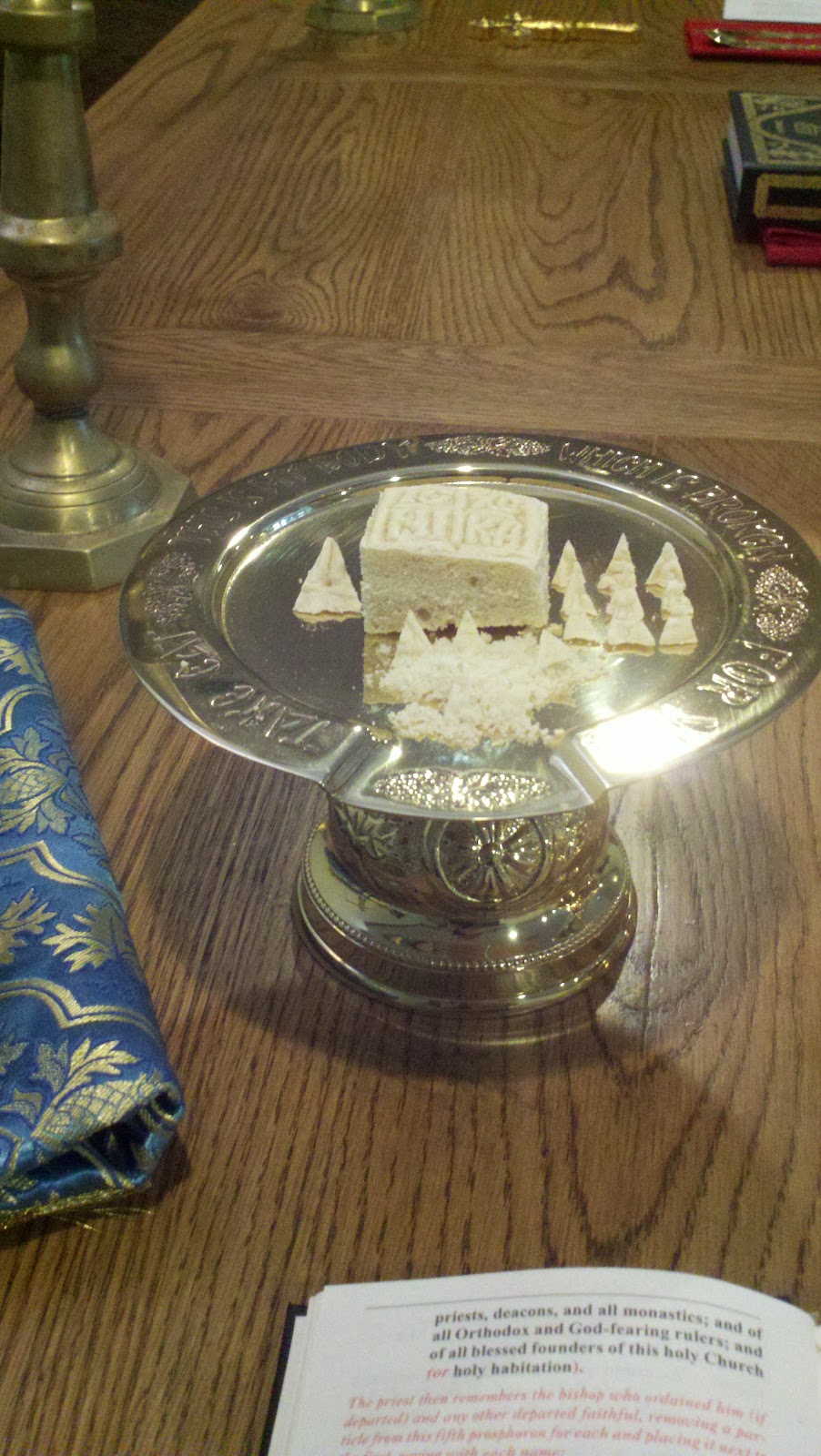
Here the north end of the altar table is set up for proskomide, which is the service for the preparation of the Host for communion.  The five loaves will be cut and divided while a series of prayers is said.  Each portion of the bread that is cut has a symbolic, commemorative significance.  The knife that is used to cut the prosphora is called the spear, after the spear that pierced Christ's side.  The chalice is the heavy ornate bronze cup from which we commune.  The Orthodox practice a full, closed communion, meaning that the bread and wine are mixed when consecrated, and taken together, and that you have to be an Orthodox Christian in good standing to commune.  The brass raised plate next to the chalice is the paten, which holds the prosphora until the consecration, when the Host is placed in the chalice.  The two cruets hold water and wine, which are commingled in the chalice during proskomide.  The blue altar cloths are placed over the paten and the chalice later.


Here Fr. Benedict begins the prayers of the proskomide.  Blue vestments are customary for the feasts of the Theotokos, and during the Dormition fast.  Fr. Benedict is wearing what is commonly referred to as Athonite or Russian vestments, with a high back that rests on his shoulders.


Here the Host is ready, at the conclusion of the proskomide service.  The large triangle to the left of the Host symbolizes the Virgin Mary; the nine small triangles to the right of the host symbolize, from left top going down the rows, the following: 1) St. John the Baptist, the Forerunner, the Prophet of the New Testament; 2) the Old Testament prophets and all holy prophets; 3) the Holy Apostles; 4) the holy hierarchs of God; 5) the holy martyrs of God; 6) the holy and venerable fathers and mothers (ascetic saints); 7) the holy unmercenaries (healers); 8) the forebears of God Joachim and Anna and the saints Equal-to-the-Apostles; 9)  the saint whose liturgy is celebrated that day (either St. John Chrysostom or St. Basil the Great).  The rows below the Host symbolize the living and the dead, according to the list Fr. Benedict had at the table with him.


Fr. Benedict here has moved the paten and chalice to the side altar table, usually called the proskomide table.  The altar table has on it the Gospel, which rests atop the folded up antimension, or altar cloth, which may be carried and used anywhere for a eucharistic service.  The antimension has sewn into it relics of a saint, and has been consecrated by a bishop and blessed for eucharistic services.  Next to the Gospel and antimension are the communion cloth, upon which sits the spoon and the spear, and above which sit the blessing cross.  Our blessing cross is a travel blessing cross from Russia.  Most Orthodox blessing crosses are quite large.  Ours is small, simply because we are a small mission and don't have our own space.


Here Fr. Benedict preaches a sermon on the miracle of the feeding of the multitudes with the seven loaves and a few fishes.  In the life of the Church and in the Gospels, this is the second such feeding which is read about in the Church.  Fr. Benedict told us that we should be astounded by this, and particularly because the Apostles were astounded by this, and this was the second time in Christ's ministry that he had done this.  The Apostles should have remembered.  And so should we, and we should marvel at it.


The Alfords, back where they should be (with us in the mission).  Note the large vascular surgeon in the background.  Please note that although we are sitting, this is only during the sermon.  We worship on our feet, or on our knees.

These photos were taken by me, on my camera phone.  The quality of the photos are a direct reflection of my quality as a photographer.

Saturday, August 4, 2012

The Divine Liturgy of St. John Chrysostom

We had a truly inspiring turnout this morning at the Mission.  We actually filled the chapel.

Fr. Benedict was kind enough to allow me to photograph the paten and the prosphora at several different stages of the Proskomide.  I will be posting those photographs tomorrow, with a partial explanation.

It was quite gratifying to have so many people helping the choir.  The sound filled the room, and even overpowered what my grandmother would have referred to as "the whole zoo."  That's actually a Russian idiom.  Out of thirty-one people, we had eleven children.

No comment, other than to say that the child I think of as Chewbacca (because of his enormous lung capacity and voice) actually told another kid to be quiet during the reading of the Gospel.  It was really quite amazing and touching.

Thursday, August 2, 2012

Baking prosphora tonight

With the first Divine Liturgy since June scheduled for Saturday in Hattiesburg at the Holy Cross Mission, I am once again baking prosphora.  The process begins with prayer and preparation (shooing the animals out of the kitchen, etc.) and Official Wife Tina shall be photographing.  The goal today is to make one ten-loaf batch (five for Saturday, five for the freezer).  The recipe is a basic 70% hydration french-style bread, meaning white whole wheat flour (unenriched, unbleached, unbromated), bread yeast, sea salt, and water.  Nothing else.

In the Russian style, our loaves have two halves, and are circular.  The top half is traditionally slightly smaller than the bottom half, and the seal IC XC/NIKA (literally, Jesus Christ Conquers) is impressed into the surface of the top half.  The loaves should be fully cooked, but not browned.

At least one of the loaves should have an intact seal for the preparation of communion.  After baking, the loaves are prepared for the Eucharistic service during the Proskomide service, which immediately precedes the Divine Liturgy and in the OCA typically occurs while the Reader is chanting the Third and Sixth Hours.

I will explain the order of Divine Services in a forthcoming post; for our purposes, it is enough to note that chanting the Third Hour takes about ten minutes, and chanting the Sixth Hour takes about ten minutes.  Proskomide takes about fifteen minutes to complete, and occurs behind the iconostasis on a special table set back and to the left of the altar table (liturgically speaking, in the Northeast corner of the church building).

It appears I will have to explain church architecture in a future post as well.  I think I will solicit a guest blog on that subject from Dr. John Mark Nicovich of William Carey University.